Ryanair’s Spain helplines never put you through to a person: FACUA accuses airline of fake customer service lines
By Adam Woodward • Published: 05 Sep 2026 • 11:37 • 2 minutes read

Passengers boarding a Ryanair flight. Credit: Hans Elmo - Shutterstock
FACUA-Consumidores en Accion, the Spanish consumer agency, has asked Spain’s consumer ministry to fine Ryanair after testers found the airline’s advertised Spanish phone lines never connect callers to a member of staff.
Complaints went to the Ministry of Social Rights, Consumer Affairs and Agenda 2030 on 3 September. Ryanair has so far not issued a public reply.
Two advertised numbers, no person on the line
FACUA checked the numbers Ryanair still publishes for Spain: 900 751 463 and 872 580 512. Both are on the airline’s own Spanish help pages as lines for new bookings and general queries. Testers say every call, whatever the reason, stays on an automated loop. Basic recordings play, then the system tells you to use the website or app and cuts you off.
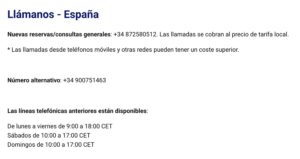
Credit: Ryanair.com
Repeat calls work no better according to the consumer group. Once the system spots you have already rung, it still refuses a human and sends you back to ryanair.com. FACUA says it has given the Consumo Ministry recordings that show there is no route to a live agent on either number.
That is important for British residents and holidaymakers who still treat a phone call as the last throw of the dice when an app chat stalls, a delayed flight needs sorting, or someone without a smartphone needs help.
Why FACUA says Spanish law is being ignored
Article 21.2 of Spain’s general consumer law (Royal Legislative Decree 1/2007) already says companies that use the phone for customer service must give direct personal attention. Automated tools are allowed only as a complement, not as the whole service. Air transport is treated as a basic service of general interest, which tightens that duty.
Ley 10/2025 on customer-service standards, in force since 28 December 2025, goes even further. Passenger airlines operating in Spain are covered, including foreign carriers. Article 8.1 bans answering machines or similar systems as the only way of dealing with customers. Callers must be able to ask for a real person from the menu and at any point during the call. That person has to identify themselves. Companies have until 28 December 2026 to finish adapting systems, but the older article 21.2 duty was already there.
Consumo Ministry asked to open a sanction file
FACUA wants the Directorate-General for Consumer Affairs to open a file and issue a fine matching the seriousness of the practice. No official finding has been published yet. This is a complaint, not a conviction.
Ryanair’s corporate news site has said nothing about the case. Help pages still list both numbers and note that only calls connected to agents are recorded. FACUA has taken Ryanair on before; one Alicante family recovered €508 after a cancelled flight with the group’s help.
What disgruntled customers can do in the meantime
Keep a note of dates, times and what the recording said. Ask clearly for “atencion personalizada” in Spanish or an “operador”. Use the airline’s written channels as well, and if that goes nowhere, an “hoja de reclamaciones” or a regional consumer office (OMIC) is the next step. FACUA’s full complaint is on its website. Ley 10/2025 itself is on the BOE. Ryanair’s listed Spain numbers are still on its help centre.
Spain’s Congress spelled out the wider customer-service overhaul when the law was approved. Airlines have already been told they must offer proper phone access rather than paid or blocked lines. Whether Consumo now treats Ryanair’s robot-only numbers as a breach is the test that follows.
Follow Euro Weekly News on Google News
Get breaking news from Spain, travel updates, and expat stories directly on your Google News feed.
Follow on Google NewsSign up for personalised news
Subscribe to our Euro Weekly News alerts to get the latest stories into your inbox!
By signing up, you will create a Euro Weekly News account if you don't already have one. Review our Privacy Policy for more information about our privacy practices.





Adam Woodward
Adam is a writer who has lived in Spain for over 25 years. With a background in English teaching and a passion for music, food, and the arts, he brings a rich personal perspective to his work at Euro Weekly News. As a father of three with deep roots in Spanish life, Adam writes engaging stories that explore culture, lifestyle, and the everyday experiences that shape communities across Spain.
Comments