‘A shocking moment’: Far-right AfD makes history in Germany as political tide shifts in Spain and Britain
By Harry Dennis • Published: 07 Sep 2026 • 13:28 • 5 minutes read
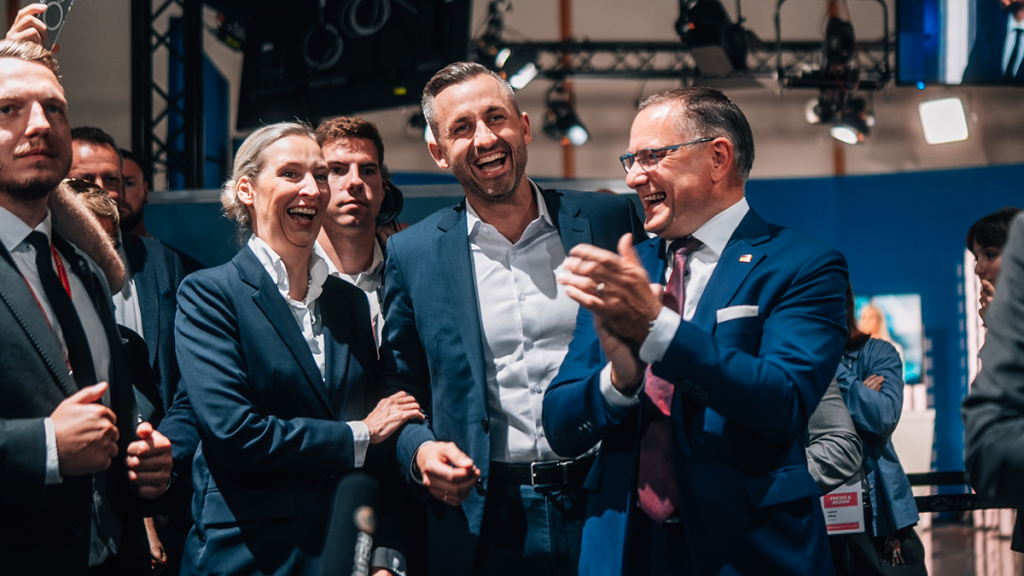
AfD co-leader Alice Weidel, lead candidate Ulrich Siegmund and co-leader Tino Chrupalla celebrate the party’s election victory in Saxony-Anhalt. Credit: Alice Weidel / X
While the AfD celebrated a result few once thought possible in post-war Germany, the silence from Chancellor Friedrich Merz told a story of voters losing faith in the parties that once dominated European politics.
On Sunday night, jubilation erupted inside the AfD’s election gathering in Magdeburg. Party leaders embraced, supporters waved German flags and Ulrich Siegmund, a 35-year-old once presented as a figure from the political margins, stood smiling at the centre of the room.
Some 130 kilometres away in Berlin, Friedrich Merz watched the results arrive at Christian Democratic Union (CDU) headquarters before leaving without addressing the country. His party had just lost half its support in a state it had governed since 2002.
The AfD won 43.8 per cent in Saxony-Anhalt, more than doubling its result from five years ago. The CDU collapsed from 37.1 per cent to just 17.2 per cent. But this isn’t just a story of voters moving further to the right. It’s also a story of people who have stopped believing conventional politics offer anything to them or their country.
The voters who’d stopped turning up
Around 170,000 people who didn’t vote in 2021 returned to the ballot box specifically to support the AfD. Another 82,000 deserted the CDU for the party, while approximately six in 10 manual workers are said to have backed it. Voter turnout climbed from around 60 per cent to 77 per cent, the highest recorded in the state.
The election clearly wasn’t one shaped by apathy. It was an unusually mobilised electorate determined to make its anger visible. For years, established parties could dismiss the AfD as a protest movement on the political fringes, but that perspective becomes quite impossible to sustain when a party wins nearly 44 per cent and finishes first in every municipality in the state.
Saxony-Anhalt’s AfD branch is classified as a confirmed right-wing extremist organisation by the state’s domestic intelligence service, a designation the party rejects. But hundreds of thousands of voters supported it regardless. The harder question to ask is why, and what has changed.
Germany’s old promise no longer feels secure
Germany’s political centre rested for decades on a powerful promise: stable government, secure employment and an industrial economy capable of delivering a better life. However, for years now, that confidence has been badly shaken. Households have faced expensive energy and rising prices, while concern has grown over industry, employment and the future of Germany’s once-dominant economic model. Its struggling car sector, long a source of national pride and well-paid jobs, has become a symbol of that uncertainty.
In Saxony-Anhalt, voters identified the economy, social security and education among their main concerns. More remarkably, they increasingly trusted the AfD to provide answers.
In 2016, 48 per cent considered the CDU the party best able to advance the state’s economy. Only 5 per cent chose the AfD. This time around though, the CDU fell to 28 per cent and the AfD reached 30 per cent, according to exit polling for ARD, Germany’s main public broadcaster,.
A party once chosen principally to shake the system is increasingly being treated as one that might be fit to run it.
Migration remained one of its most effective campaigning issues, even though foreign nationals account for only around 8 per cent of Saxony-Anhalt’s population. Cultural disputes and anxiety over European security also contributed heavily towards voters’ arguments behind their decisions.
Above them all was a devastating judgement on those already governing: 87 per cent were dissatisfied with the federal government, and only one in five believed it could move Germany forward. Merz entered office promising decisive leadership and economic renewal. Instead, many voters see another government caught between competing positions and unable to explain where it is taking the country.
Spain has its own crisis of confidence
The political circumstances in Spain are different, but the public frustration is increasingly familiar. The fallout from the arrival of approximately 70,000 people in Ceuta from Morocco has been driven not only by attitudes towards migration, but by the impression that the government was slow or unable to control events. Approximately 63,000 people were returned within 72 hours, and Prime Minister Pedro Sánchez described it as one of Europe’s fastest return operations and announced €309 million for Ceuta. Nevertheless, a poll for El País and Cadena SER found that 72 per cent held the Spanish government responsible for what happened, while 63 per cent judged Sánchez’s response negatively. Seven in 10 wanted stronger border controls. And Vox, the far-right Spanish Party that champions intense nationalism, recentralisation of the state, and strict anti-immigration policies, was considered the party most capable of managing immigration, ahead of both the governing Socialists and the PP.
Vox consequently reached 17.8 per cent in the poll, while the PP (Partido Popular) and Vox together passed 50 per cent for the first time during the current parliamentary term.
As in Germany, this is not necessarily evidence of millions of people suddenly embracing every policy on the right. It also reflects a belief that the government reacts only after a crisis has escaped its control. Sánchez insists that he will complete his term, potentially leaving voters without a national ballot until 2027. That gives public opinion and frustration time to harden.
Britain has changed its leader, but not people’s mood
Britain has already attempted the political reset Germany and Spain may eventually face. Keir Starmer resigned after Labour lost more than 1,300 councillors in May. Andy Burnham became prime minister in July, promising a more direct style of government and declaring that Labour would not “out-Green the Greens or out-Reform Reform”.
Six weeks later, the national mood had barely moved. YouGov placed Labour and Reform UK level on 23 per cent, with the Conservatives behind both.
Earlier research found that only 16 to 17 per cent of Britons thought the government was performing well on the economy, immigration and taxation. Between 72 and 75 per cent believed it was doing badly.
Changing the person at the top has seemingly unaided the change in feeling that the system beneath him is failing.
Keeping the AfD out will not make the anger disappear
Despite its victory, the AfD remains three seats short of a majority in Saxony-Anhalt’s 83-seat parliament.
The CDU, Social Democrats, Greens and Die Linke refuse to govern with it but cannot easily form a stable government themselves. Five representatives from the Sahra Wagenknecht Alliance could now decide what happens. Daniel Günther, the CDU premier of Schleswig-Holstein, described the result as “a shocking moment for our country”.
Germany’s established parties may still prevent the AfD from governing. But keeping a party out of office is not the same as answering to the people who voted for it. Across Germany, Spain and Britain, parties that once relied on habitual loyalty are confronting voters who now feel poorer, less secure and increasingly ignored. Calling their choices a swing to the right describes where many votes are going and how public opinion is swaying in frustration, but it doesn’t fully explain why they are abandoning their previous parties’ support.
That is the question Europe’s political establishment can no longer avoid. As more voters tire of promises they feel have changed little in their wages, bills or communities, whether those in power can offer anything more convincing may determine where Europe turns next.
Follow Euro Weekly News on Google News
Get breaking news from Spain, travel updates, and expat stories directly on your Google News feed.
Follow on Google NewsSign up for personalised news
Subscribe to our Euro Weekly News alerts to get the latest stories into your inbox!
By signing up, you will create a Euro Weekly News account if you don't already have one. Review our Privacy Policy for more information about our privacy practices.





Harry Dennis
Born in the UK and raised on the Cádiz coast, Harry brings his background in design, music, and photography to his writing for Euro Weekly News, sharing stories that celebrate culture and lifestyle across Spain and beyond.
Comments