Murcia migrant boats: Guardia Civil says mafias have used same ‘patera taxi’ model for 10 years
By Adam Woodward • Published: 08 Sep 2026 • 11:57 • 4 minutes read

High-speed boat captains arrested. Credit: GC
Organised migrant-smuggling gangs have been using the same type of high-powered “patera taxi” boat to bring people from North Africa to the Murcia coast for around a decade, according to a new Guardia Civil report.
Francisco Pulido, colonel of the Guardia Civil’s Fifth Zone, said the method used by the networks has remained remarkably consistent, with the boats dropping passengers on Spanish beaches before heading back out to sea to collect another group.
His comments came as details were released of two recent operations in Murcia which resulted in four suspected boat operators being arrested and two high-speed boats being seized.
Government delegate Francisco Lucas described the Guardia Civil operations as highly successful while calling for respect for the ongoing investigations by Spain’s security forces.
63 migrants found at Calblanque beach
One of the cases began on August 31 when Guardia Civil officers found 63 migrants who had been brought ashore at Calblanque, Cartagena. Several of those located reportedly had injuries, while statements given to officers alleged that they had paid thousands of euros for the journey from Africa to Spain.
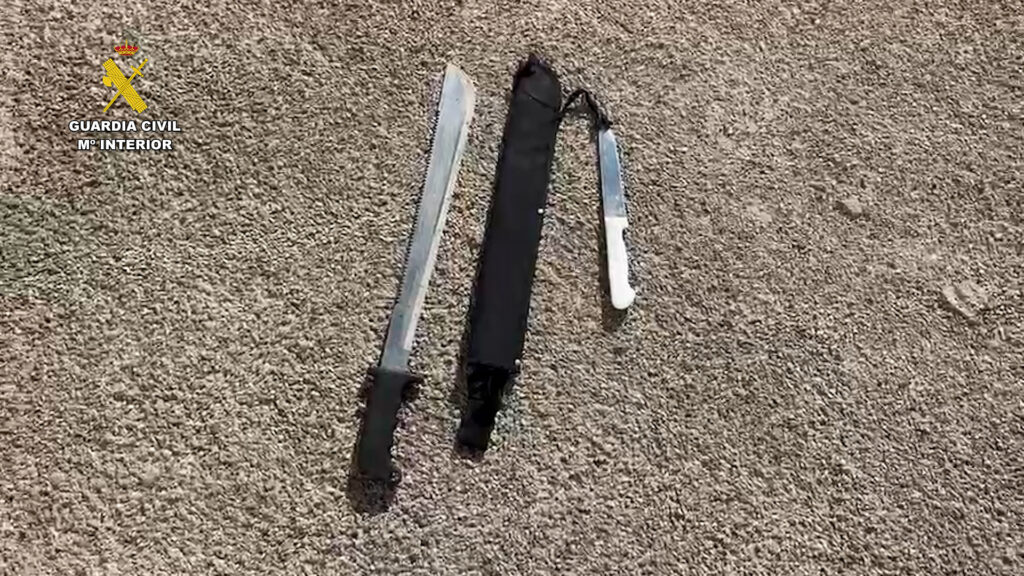
According to the Guardia Civil, passengers told investigators they had been beaten and threatened during the crossing. Some allegedly faced attacks with a machete and pepper spray as the boat approached the coast, with passengers ordered to jump into the water quickly even if they could not swim.
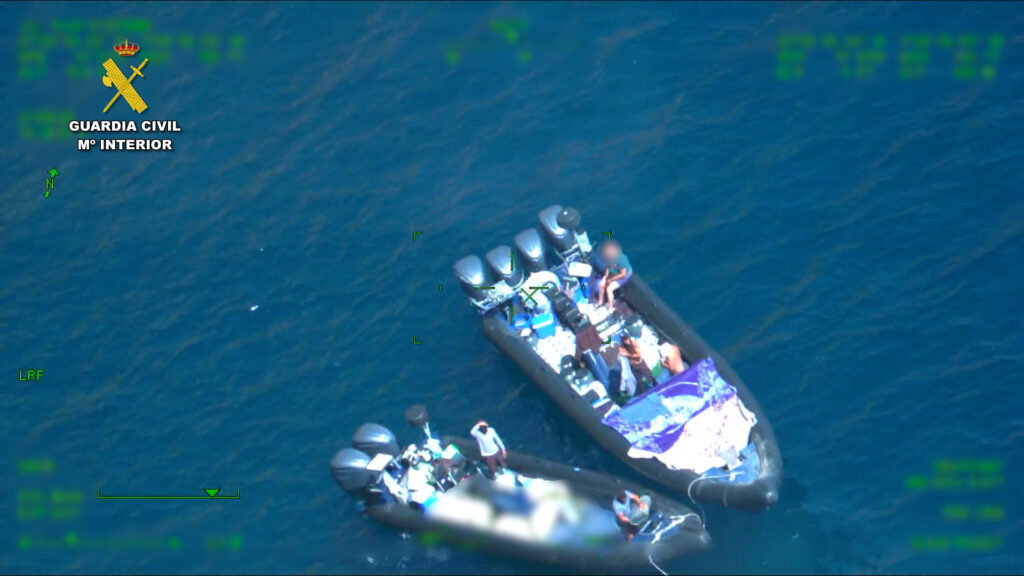
Maritime officers then followed the suspected vessel after it fled back out to sea. The boat was eventually intercepted around 12 nautical miles south-east of Monte Cenizas. Two people on board were arrested. Investigators seized a 15-metre semi-rigid speed boat fitted with four powerful engines and transferred it to Cartagena.
Credit: GC
Second boat rammed Guardia Civil patrol boat
A separate operation on September 2 turned into a dangerous pursuit off Cabo Cope near Águilas. Spain’s Integrated External Surveillance System, known as SIVE, detected a suspicious high-speed vessel in the area. A Guardia Civil maritime patrol boat and helicopter were deployed to locate it.
Suspected operators allegedly ignored repeated instructions to stop and began making evasive manoeuvres as officers attempted to intercept them. The situation became increasingly dangerous when the two boats came close to a collision. One Guardia Civil officer fired two warning shots from his service weapon without hitting anyone on board the suspect boat.
Despite the warning, the boat struck the side of the Guardia Civil patrol boat before continuing its escape. Three officers suffered minor injuries in the collision.
Investigators say those on board then began throwing fuel containers into the sea as they tried to get away. Guardia Civil crews recovered 28 petrol containers when the boat was eventually stopped and boarded. Two people were arrested in that operation.
Four suspects face a string of charges
Investigators subsequently established a connection between the two speed boats, which were both designed for high-speed operations and fitted with powerful outboard engines. Authorities say the four arrested suspects face allegations including facilitating irregular immigration, smuggling, attacking officers, causing injuries and damage, piracy and the illegal transportation of liquid fuel.
Investigators are particularly interested in the similarities between the two boats and the way they were being used.
Colonel Pulido explained that “patera taxi” operations differ from the traditional image of a migrant boat being abandoned after reaching Spain. Instead, these vessels are valuable to criminal networks because they can be turned around and used again. Once passengers have been dropped close to the Spanish coast, the boat can return towards North Africa before being loaded with another group.
New patrol boat backs up Murcia coast operation
Credit: GC
Extra maritime resources are now being brought into the Region of Murcia following a summer in which high-powered boats have repeatedly reached the coastline. Francisco Lucas announced that the fast S-40 rigid inflatable patrol boat has been put into service with reinforced engines.
A larger patrol boat, the Río Ulla, has also joined the Murcia maritime service. The 17-metre vessel has two engines producing 1,480 horsepower each, giving the Guardia Civil additional capacity for operations at sea. Lucas also said a larger vessel from Barcelona, operating under Frontex, has been assigned exclusively to waters around Murcia.
The new resources come after a series of incidents involving powerful boats rather than the smaller traditional wooden boats, or ‘pateras’, often associated with Mediterranean migrant crossings.
High-powered boats create a growing challenge
Recent events have shown how difficult these vessels can be to intercept once they reach Spanish waters. EWN previously reported how more than 160 migrants reached the Murcia coastline in a single week during August, with several boats arriving at beaches around Cartagena. The later Cabo Cope incident also demonstrated the dangers faced by officers when suspected smugglers refuse to stop.
Investigators now believe the latest cases form part of a wider system in which expensive, high-performance boats are used repeatedly rather than abandoned after a single journey.
That approach gives organised gangs the ability to move multiple groups of migrants using the same vessel, potentially generating substantial profits from each crossing. For the Guardia Civil, the challenge is therefore not simply finding migrants after a boat has reached the beach. Officers also have to identify the crews, track the vessels at sea and disrupt the wider networks supplying boats, engines and fuel.
Murcia’s new maritime resources are intended to back up that response as investigations continue.
Follow Euro Weekly News on Google News
Get breaking news from Spain, travel updates, and expat stories directly on your Google News feed.
Follow on Google NewsSign up for personalised news
Subscribe to our Euro Weekly News alerts to get the latest stories into your inbox!
By signing up, you will create a Euro Weekly News account if you don't already have one. Review our Privacy Policy for more information about our privacy practices.





Adam Woodward
Adam is a writer who has lived in Spain for over 25 years. With a background in English teaching and a passion for music, food, and the arts, he brings a rich personal perspective to his work at Euro Weekly News. As a father of three with deep roots in Spanish life, Adam writes engaging stories that explore culture, lifestyle, and the everyday experiences that shape communities across Spain.
Comments
D Bath
09 September 2026 • 13:16Spain has been considered a very safe country recently, but comparing this to what some of us experienced in the US and their border with Mexico over the last few decades, I see a very disturbing and similar trend emerging here. Couple that with the rampant open border policies supported by many liberals and current events in Ceuta, it paints a very troubling picture.
Adam Woodward
09 September 2026 • 13:29It seems, someone is encouraging them to make the dangerous journey.
Jack
09 September 2026 • 18:06Perhaps The french!? 🤔🤬
Comments are closed.