From Gold Certificates to Stablecoins: The long history of representative money
By Nicola EWN • Published: 22 Sep 2026 • 9:42 • 5 minutes read

Image: AI Generated
On August 15, 1971, Richard Nixon appeared on television and announced that the United States would no longer convert dollars to gold. The announcement ended a system that had, in various forms, governed most of global finance for the better part of a century.
What Nixon terminated that evening was representative money explained in its most consequential incarnation: the idea that a piece of paper issued by a government derives its value from a physical commodity sitting in a vault somewhere, redeemable on demand. The world that emerged from that decision, the entirely fiat world every currency trader operates in today, is easier to understand when you see what it replaced and why.
The basic structure and why it was invented
Representative money solved a practical problem with the obvious predecessor. Commodity money, coins made of gold or silver, was the original hard currency: the coin was valuable because the metal was valuable. But gold and silver coins are heavy, difficult to divide precisely, and impractical for large transactions. A merchant completing a significant trade in the 17th century who needed to move payment across distances faced a logistics problem that paper could solve.
Goldsmiths and early banks hit on the solution: deposit your gold with a trusted custodian, receive a paper receipt documenting the claim, and trade the receipt instead of the metal. The paper had no intrinsic value. A gold certificate is just paper. But the claim it represented, the right to walk into the vault and exchange it for physical gold, transferred the commodity’s value to the paper through the mechanism of redemption.
Two conditions had to hold for the system to work. First, the custodian actually had to hold the gold that the certificates claimed. Second, not everyone could demand redemption simultaneously. Both conditions failed regularly throughout history, which is why representative money systems cycled through periods of stability and crisis with notable consistency.
The classical gold standard and its operating logic
The gold standard era, roughly 1870 through 1914, represented representative money at its most disciplined and most constraining. Major economies pegged their currencies to gold at fixed rates. A British pound was a fixed claim on a specific weight of gold. A US dollar was the same. Exchange rates between currencies were stable as a consequence because both were claims on the same commodity at defined ratios.
The discipline was enforced automatically. If a country ran a trade deficit and more gold flowed out than in, the domestic money supply contracted, prices fell, exports became cheaper and more competitive, and the deficit corrected itself. No central bank needed to manage this: the mechanism was self-adjusting through the gold constraint. The cost of that automaticity was inflexibility. Governments could not respond to recessions by expanding money supply. Wartime spending could not be monetised. The gold backing was either honoured or the system collapsed.
World War I demonstrated the constraint’s breaking point. The combatant nations needed to finance military operations on a scale that gold reserves could not support. Britain, France, Germany, and others suspended gold convertibility in 1914, effectively abandoning representative money for the duration of the war. When they tried to restore it afterward, often at pre-war exchange rates that no longer reflected the economic realities of the 1920s, the result was deflation, unemployment, and eventually the Great Depression pressures that ended the attempt entirely.
Bretton Woods: The last international representative money system
The architects of postwar finance, meeting at Bretton Woods, New Hampshire in 1944, designed a modified representative money system that tried to capture the stability of the gold standard while allowing more policy flexibility. The US dollar was pegged to gold at $35 per ounce. Every other major currency was pegged to the dollar. Only central banks, not private holders, could redeem dollars for gold.
The system worked while the United States held the overwhelming majority of the world’s monetary gold and ran consistent trade surpluses. As European economies recovered and the US began running deficits, the dollar’s gold backing came under increasing strain. The US was issuing more dollars than its gold reserves could back at $35 per ounce. Foreign central banks began converting their dollar holdings to gold, depleting US reserves.
Nixon’s 1971 decision was the endpoint of this process. By August of that year, the dollar’s gold backing had become a fiction that the market had already priced. Closing the gold window did not destroy the dollar’s value: what it did was formalise that the dollar’s value rested on government credibility and institutional trust rather than commodity backing. Every major currency made the same transition at various points. None has returned to representative money since.
Stablecoins as digital representative money
The structure that defined gold certificates for a century reappeared in crypto markets in digital form. A USDC token is a claim on a dollar held in Circle’s reserve accounts, redeemable on demand. USDT is a similar claim on Tether’s reserves. DAI, though more complex in its algorithmic collateral structure, attempts to maintain a dollar claim through a different mechanism. Each of these is functionally representative money: the token itself has no intrinsic value, and its value derives entirely from the quality and existence of the reserves backing the claim.
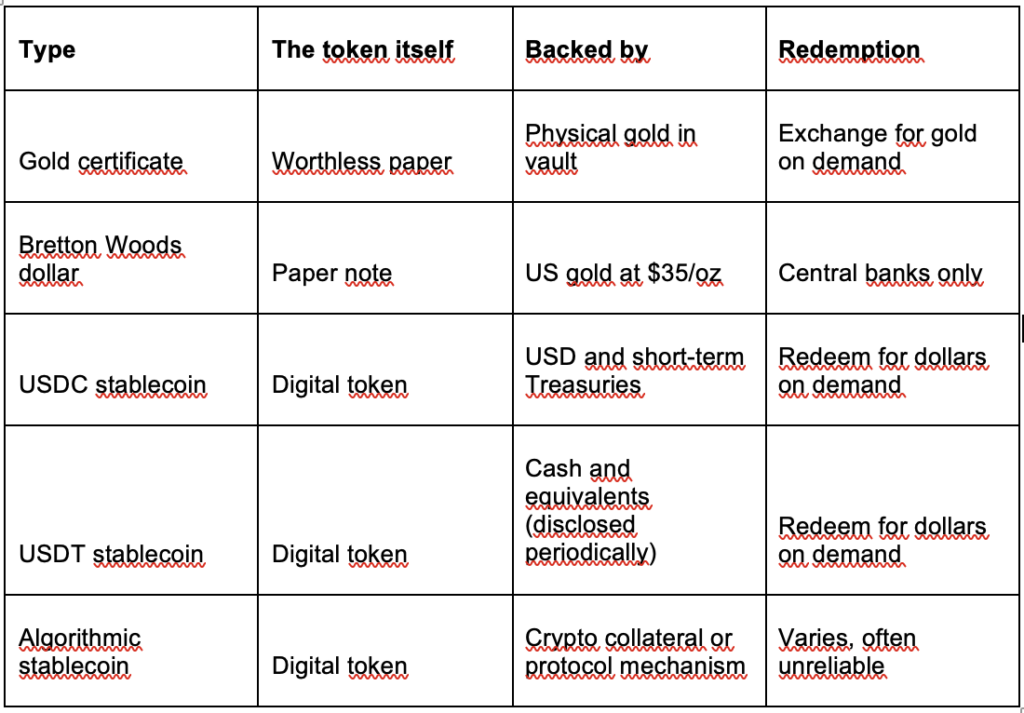
The parallels to historical representative money extend to the failure modes. TerraUSD in 2022 was algorithmic representative money whose mechanism for maintaining the dollar peg failed under redemption pressure, exactly as gold standard systems failed when governments could not actually deliver the commodity they had promised. USDC operates more like a well-managed gold standard: the reserves are audited by third parties, the composition is disclosed monthly, and the redemption mechanism has been tested and held. Tether has a longer record of controversy around reserve composition transparency, echoing the historical problem of issuers who claimed more backing than actually existed.
What representative money’s history tells us about current debates
The argument about Bitcoin as digital gold is partly an argument about whether representative money’s constraints were desirable or not. Critics of fiat money argue that the gold standard’s discipline prevented the monetary debasement and inflation that fiat systems have produced. Defenders argue that the rigidity that prevented debasement also prevented necessary crisis responses: the 2008 and 2020 responses, which involved dramatic money supply expansion, would have been impossible under any representative money system.
Bitcoin’s design reflects a deliberate choice to prioritise the scarcity property over the flexibility property. The 21 million coin limit enforces digital scarcity through protocol rules in a way that mimics the gold standard’s supply constraint without requiring a physical commodity. But Bitcoin is not representative money: it is not a claim on anything external. It is closer to the coin itself in the commodity money framework, except the commodity is secured by cryptography and distributed consensus rather than metallurgical rarity.
This distinction matters for understanding where Bitcoin fits in monetary history. It is not a return to the gold standard. It is an attempt to recreate the scarcity property of commodity money in digital form, dispensing with the representative layer entirely. Whether that attempt succeeds in the long run depends on the durability of the consensus that gives the protocol its authority, which is itself a question without historical precedent.
Conclusion
Representative money solved the weight problem of commodity money and ran the global financial system for the better part of a century before its internal tensions became unsustainable. The gold standard’s automatic discipline prevented monetary debasement at the cost of economic flexibility. Bretton Woods tried to compromise and eventually reached the same endpoint. The fiat era that followed removed the commodity constraint entirely, giving central banks unlimited policy flexibility while removing the anchoring mechanism that kept supply growth bounded. Stablecoins are the most direct digital descendant of representative money, applying the same claim-on-reserves structure to a blockchain token. Their reliability follows the same logic: it depends entirely on whether the custodian actually holds what the token claims, and whether the redemption mechanism holds under pressure.
Follow Euro Weekly News on Google News
Get breaking news from Spain, travel updates, and expat stories directly on your Google News feed.
Follow on Google NewsSign up for personalised news
Subscribe to our Euro Weekly News alerts to get the latest stories into your inbox!
By signing up, you will create a Euro Weekly News account if you don't already have one. Review our Privacy Policy for more information about our privacy practices.





Nicola EWN
Nicola is a writer and strategist working across culture, media, and digital editorial. With broad industry experience, she helps brands and publications shape compelling narratives and engaging online content.
Comments