Secret Nazi plans to invade Gibraltar released in English for the first time.
By Molly Grace • Published: 29 Sep 2026 • 16:16 • 5 minutes read
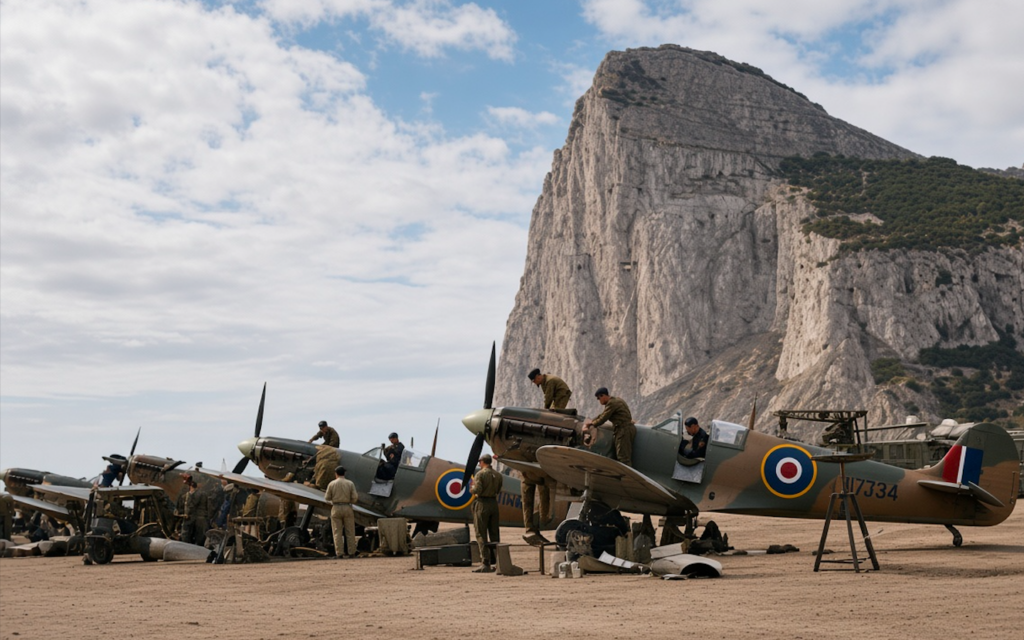
Gibraltar's wartime garrison could number around 10,400 men. Photo credit:War Office official photographer, Dallison G W (Lt), No. 1 AFPS, Army Film and Photographic Unit/CC Wikipedia
For anyone living along or visiting the Costa del Sol, Gibraltar is a familiar sight on the horizon, but newly translated wartime files reveal just how close the region came to becoming part of one of Nazi Germany’s most ambitious military plans. German troops were expected to move through Spain before launching an assault on the Rock, with roads, supply routes and military preparations mapped out across the country.
More than 85 years after Nazi Germany drew up plans to seize Gibraltar, readers can now examine the German military’s own invasion plans for the Rock. The documents reveal a proposed operation involving tens of thousands of troops, hundreds of aircraft and plans for smashing through Gibraltar’s defences.
Inside Hitler’s Gibraltar invasion plan
The documents reveal that Operation Felix was far more than an idea for taking Gibraltar. German planners worked out how tens of thousands of troops would reach the Rock, where artillery would fire, which defences had to be destroyed and how infantry would push into the fortress.
The newly translated files, made available by Gibraltar’s Ministry for Heritage, contain operational orders, intelligence reports, maps, photographs, artillery plans and logistical documents relating to the proposed assault.
Nearly 50,000 men were being prepared
One of the most striking documents, Case 627, lays out the scale of the force being prepared. Around 47,500 personnel, 12,550 vehicles and 1,700 horses and pack animals were expected to move from France through Spain towards Gibraltar. The troops were divided into marching groups, with road routes, rail movements, staging areas, billeting arrangements and timetables worked out in detail.
The journey itself required a huge logistical operation. Documents identify routes through Biarritz, Hendaye, Madrid, Valladolid, Cáceres and Sevilla, while supply points were planned at Valladolid, Garrovillas and Sevilla. Fuel, rations, ammunition, hospitals, workshops, repair facilities, transport columns and railway unloading points were all part of the preparations, with large ammunition stocks planned along the route.
German guns had hundreds of targets
The plans also show exactly what German commanders believed needed to be destroyed before troops could enter Gibraltar. Case 302 contains detailed artillery planning for Operation Felix, including firing schedules, gun positions, observation posts and target maps. These covered the North Mole, Old Mole, Casemates, Seaplane Station, searchlights, radio installations and defensive positions.
Across the collection, German planners identified hundreds of potential targets, including the Land Port, Castle Walls, Casemate Barracks, King’s Bastion, galleries and tunnel entrances, observation posts, artillery batteries, anti-aircraft positions, harbour installations, power stations and communications centres. German intelligence had also estimated that Gibraltar’s wartime garrison could number around 10,400 men, compared with roughly 3,200 in peacetime. Reports assessed the fortress artillery, anti-aircraft network, command posts, machine-gun positions, walls, bastions and defensive lines.
The artillery preparation was designed to begin before the main assault. German guns were expected to carry out counter-battery fire, destroy defensive positions, suppress anti-aircraft guns and breach obstacles before moving barrages advanced ahead of the infantry in 200-metre bounds.
The attack was timed down to a T
The operational orders show just how precisely the assault had been planned. Mountain Infantry Regiment 98 was expected to attack the eastern sector after a two-hour artillery preparation, with engineers clearing breaches through the outer defences. One set of orders scheduled artillery fire for 9.10am, followed by the main infantry attack at 1.10pm.
The III Battalion was assigned areas including the cemetery, terraces above the lagoon and the Moorish Castle, while the I Battalion was tasked with the eastern flank, fortified positions, anti-tank obstacles, the drawbridge and wall sector, Catalan Bay and the ridge. The troops would have been supported by engineers, anti-tank guns and rifles, heavy infantry weapons and artillery observers. Communications were planned through telephone and field wire, radio, runners, visual signals and even carrier pigeons.
Stukas were to cover Gibraltar in smoke
Smoke was another major part of the proposed assault. Case 397 contains orders for the German Smoke Regiment, or Nebeltruppe, with Nebelwerfer Battalion 4 assigned to the western assault group around the Old Mole, drawbridge, lagoon and Windsor Battery. Nebelwerfer Battalion 1 was positioned for the eastern assault group, including positions east of La Línea. Its job was to create continuous smoke over the northern summit and prevent British observers from seeing German movements around La Línea, the forward area and the approaches from Spain.
The Luftwaffe was expected to contribute roughly 800 aircraft, with missions including attacks on Gibraltar, suppression of anti-aircraft positions, reconnaissance, photography and the creation of smoke screens. Stuka dive bombers were even allocated 50-kilogram smoke bombs and were expected to make repeated attacks approximately every 15 minutes until the required smoke screen had been established. Once German troops had broken through, the smoke from Nebelwerfer Battalion 4 was planned to shift towards the terraces between the Moorish Castle and Windsor Battery.
Gibraltar was being studied from the ground up
The level of intelligence gathering behind the operation shows how much information German planners had assembled before the proposed assault. They drew on fortress studies, agent reports, Abwehr assessments, aerial photographs, stereoscopic imagery, telephoto photography, maps, terrain information and assessments of weather and tides. Their picture was considered reasonably accurate, although there were gaps around parts of Gibraltar’s eastern face and tunnel system.
The intelligence work was not limited to the fortress itself. German reports examined the surrounding approaches and gathered information that could be used to plan troop movements, artillery fire and the assault. Together, the material gave German commanders a detailed picture of the ground they would have to cross and the obstacles they would face.
Franco was drawn into the invasion plans
Spain was at the heart of the planning, with Admiral Wilhelm Canaris discussing the proposed operation with Francisco Franco and senior Spanish military officials in 1940. Franco supported the military planning, but Spanish officials were concerned about how Britain might respond, particularly given the Royal Navy’s presence around Gibraltar.
German plans relied on Spain for much more than simply allowing troops to cross the country. The documents cover Spanish assistance with reconnaissance, labour, security, transport, hospital trains, concealment and protecting supply routes. Spanish officials also warned that keeping such a large operation secret would be difficult because Britain could observe troop concentrations, artillery movements and engineering work around Gibraltar.
Why Operation Felix never happened
The biggest problem was that the Germans never secured the political agreement and practical cooperation needed to put the invasion into action. Spain was economically exhausted after its Civil War, and Franco was concerned about the consequences of provoking Britain.
Hitler’s attempts to bring Spain into the Axis war effort, including discussions with Franco, did not produce the commitment required for Felix to proceed. As a result, despite the German preparations, Operation Felix was never launched. Gibraltar remained under British control throughout the Second World War, while the invasion plans eventually became wartime documents rather than an actual attack.
Follow Euro Weekly News on Google News
Get breaking news from Spain, travel updates, and expat stories directly on your Google News feed.
Follow on Google NewsSign up for personalised news
Subscribe to our Euro Weekly News alerts to get the latest stories into your inbox!
By signing up, you will create a Euro Weekly News account if you don't already have one. Review our Privacy Policy for more information about our privacy practices.





Molly Grace
Molly is a British journalist and author who has lived in Spain for over 25 years. With a background in animal welfare, equestrian science, and veterinary nursing, she brings curiosity, humour, and a sharp investigative eye to her work. At Euro Weekly News, Molly explores the intersections of nature, culture, and community - drawing on her deep local knowledge and passion for stories that reflect life in Spain from the ground up.
Comments