Mortar bomb shipment spilled over Spanish public road
By Adam Woodward • Published: 13 Oct 2026 • 23:51 • 3 minutes read
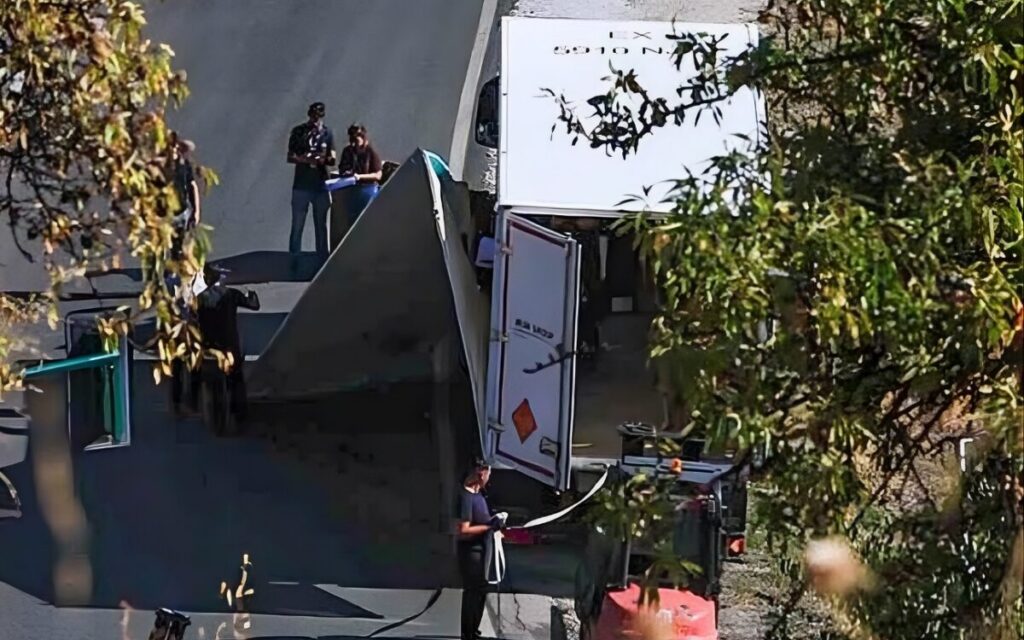
Bombs spill over and rip through lorry walls. Credit: @iberianludus X
A lorry carrying mortar grenades and other explosives from the Fábrica de Municiones de Granada lost part of its load in the middle of a public main road on Tuesday afternoon, forcing a full road closure and the evacuation of nearby homes, according to local press.
Residents in the El Fargue area of Granada woke up to a tense scene after the vehicle, travelling between two sites belonging to the same company, suffered an internal load shift, indicating that the load might not have been well tied down. According to local reports, the movement was so strong it ripped open the side of the truck and scattered rounds of mortar shells across the carriageway. Guardia Civil officers ordered people living within a 100-metre radius to leave their properties while specialists worked to make the area safe.
📢⚫️Especial precaución en Granada por el corte de la A-4002 en el entorno de El Fargue.
⚠️Eviten circular por la zona y sigan las indicaciones de los servicios de emergencia. https://t.co/DQ6y8OZI26
— Dir. Gral. Tráfico (@DGTes) October 13, 2026
Bomb disposal teams and emergency crews on the scene
TEDAX explosive ordnance disposal experts (bomb disposal), Guardia Civil, National Police, local police and firefighters all responded quickly. Andalucia’s emergency service activated the pre-emergency phase of the plan for accidents involving dangerous goods, a standard step when munitions or explosives are involved on public roads. No injuries were reported, and officials later said the rapid arrival of the bomb squad meant there was never any real danger to the public.
Police later suggested the incident was probably caused by the load not being properly secured. The company itself confirmed it had been a short internal transfer between its own facilities rather than a long-distance export run, and said it had opened its own investigation. Traffic on the A-4002 was restored later the same afternoon once the rounds had been cleared.
Why this factory is important for Spain’s defence industry
The plant in El Fargue is one of Europe’s oldest continuous ammunition producers, with roots going back centuries. Since 2020 it has been owned by Slovak firm MSM Group, part of the larger Czech Czechoslovak Group (CSG). Demand for large-calibre shells, propellants and mortar rounds has risen sharply because of the war in Ukraine and wider European rearmament, and the factory has expanded its workforce and output to meet contracts. You can read more background on the Fábrica de Municiones de Granada.
Much of what leaves the site ends up with European and NATO customers. Some of the group’s production is also linked, either directly or through the parent company, to supplies that support Ukraine. Spain’s overall military support to Ukraine has included both government donations (such as Leopard tanks and air-defence equipment) and commercial sales of ammunition. Estimates put cumulative Spanish military aid in the region of several billion euros since 2022, with ammunition forming a large share of the commercial side. Euro Weekly News has previously covered Spain’s Leopard tank deliveries and a €615 million military aid package. Earlier reporting also noted Ukrainian criticism that some early Spanish shipments were only enough for two hours of fighting, while other flights carried large-calibre ammunition. Commercial ammunition exports, including from plants like this one, have been substantial — one analysis tracked around 140,000 155 mm shells in a relatively short period.
Rules for moving this kind of cargo
Transporting explosives and ammunition in Spain is tightly controlled under national explosives regulations and the international ADR rules for dangerous goods. Vehicles must meet specific safety standards, specialised “vigilantes de explosivos” security staff are normally required, and journeys need official authorisation, emergency plans and reliable communications with the Guardia Civil. Depending on the quantity and route, an official police escort can also be ordered.
Local moves between a company’s own sites can sometimes operate under lighter escort conditions than long-haul export shipments, but the basic safety rules still apply.
Tuesday’s spill has raised fresh questions among local residents about how such loads are handled on ordinary roads close to homes. The factory has grown into an important industrial site for Granada province, driving a noticeable rise in arms-related exports in recent years. At the same time, any accident involving live munitions on a public highway is bound to draw attention, especially when the material is of a type that has been in high demand for the conflict in Ukraine.
Authorities have not released a detailed public statement beyond the basic facts of the road closure and the activation of the emergency plan. The company’s investigation into the load shift is ongoing. For now, the road is open again and no one was hurt, but the incident has put a spotlight on the practical realities of moving military-grade ammunition through residential areas in southern Spain.
Follow Euro Weekly News on Google News
Get breaking news from Spain, travel updates, and expat stories directly on your Google News feed.
Follow on Google NewsSign up for personalised news
Subscribe to our Euro Weekly News alerts to get the latest stories into your inbox!
By signing up, you will create a Euro Weekly News account if you don't already have one. Review our Privacy Policy for more information about our privacy practices.





Adam Woodward
Adam is a writer who has lived in Spain for over 25 years. With a background in English teaching and a passion for music, food, and the arts, he brings a rich personal perspective to his work at Euro Weekly News. As a father of three with deep roots in Spanish life, Adam writes engaging stories that explore culture, lifestyle, and the everyday experiences that shape communities across Spain.
Comments