Malaga cave helps robots learn to navigate underground in Rincon
By Adam Woodward • Published: 21 Oct 2026 • 15:10 • 2 minutes read
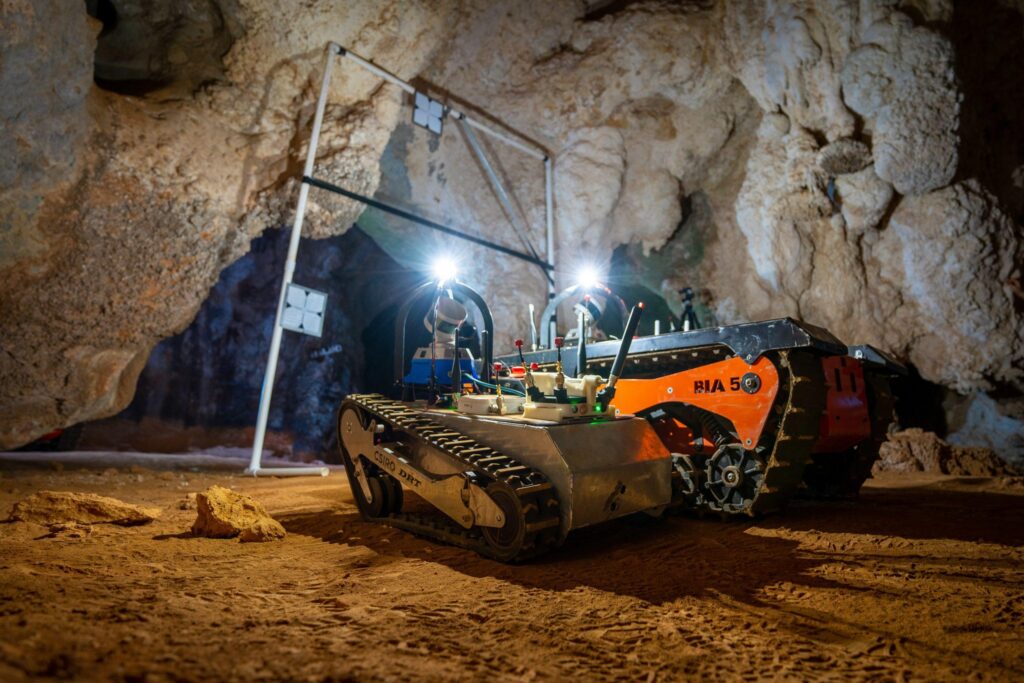
Caving robots developed in Rincon. Credit: UMA
A cave on the eastern Costa del Sol is helping international researchers develop smarter robots capable of finding their way through some of the most challenging underground environments.
Cueva de la Victoria, in Rincón de la Victoria, has been used for an international research project bringing together scientists from the University of Malaga, Turin Polytechnic and local archaeologists. The town’s caves have also attracted attention for their archaeological importance, as EWN reported in its article on Rincón de la Victoria’s Treasure Cave.
The project, known as CAVERS, has produced more than 335 gigabytes of data to help improve how autonomous robots locate themselves and map unfamiliar spaces.
Why Malaga’s cave is ideal for robot research
Natural caves pose serious challenges for robotic navigation. Near-total darkness, narrow passages, uneven rock formations and wet, reflective surfaces can all make it difficult for sensors to build an accurate picture of the surroundings.
Researchers collected 24 sequences of data in two different areas of Cueva de la Victoria. The work involved a ground-based robotic rover called DIABLO, alongside a handheld system fitted with specialist sensors.
Equipment included laser-based LiDAR, thermal infrared cameras, depth cameras and motion sensors. Ten infrared cameras were also installed inside the cave to track the rover’s movements with millimetre-level precision.
The measurements allow researchers to compare a robot’s estimated position with its actual movement, helping them test how accurately different navigation systems perform underground.
Could the technology help in dangerous places?
The findings could support future robots used to explore inaccessible caves, assist archaeological investigations and inspect hazardous locations where sending people would be difficult. The University of Malaga has previously demonstrated its work in rescue robotics, including robot-assisted searches for people in emergencies.
The dataset has been made available through an open-access scientific repository, allowing researchers worldwide to test their own systems against the same challenging conditions.
The study, published in the scientific journal IEEE Robotics and Automation Letters, is titled CAVERS: Multimodal SLAM Data From a Natural Karstic Cave With Ground Truth Motion Capture. The published research paper provides the technical details behind the project.
Although the project does not mean robots are already exploring caves independently in everyday operations, it provides scientists with valuable real-world information to improve the technology.
Cueva de la Victoria is therefore contributing to research that could eventually help machines navigate places where visibility is poor and conventional navigation systems struggle.
Follow Euro Weekly News on Google News
Get breaking news from Spain, travel updates, and expat stories directly on your Google News feed.
Follow on Google NewsSign up for personalised news
Subscribe to our Euro Weekly News alerts to get the latest stories into your inbox!
By signing up, you will create a Euro Weekly News account if you don't already have one. Review our Privacy Policy for more information about our privacy practices.





Adam Woodward
Adam is a writer who has lived in Spain for over 25 years. With a background in English teaching and a passion for music, food, and the arts, he brings a rich personal perspective to his work at Euro Weekly News. As a father of three with deep roots in Spanish life, Adam writes engaging stories that explore culture, lifestyle, and the everyday experiences that shape communities across Spain.
Comments