Heroic human chain rescue: Woman swept out to sea in Galicia
By Adam Woodward • Published: 27 Oct 2026 • 12:41 • 3 minutes read
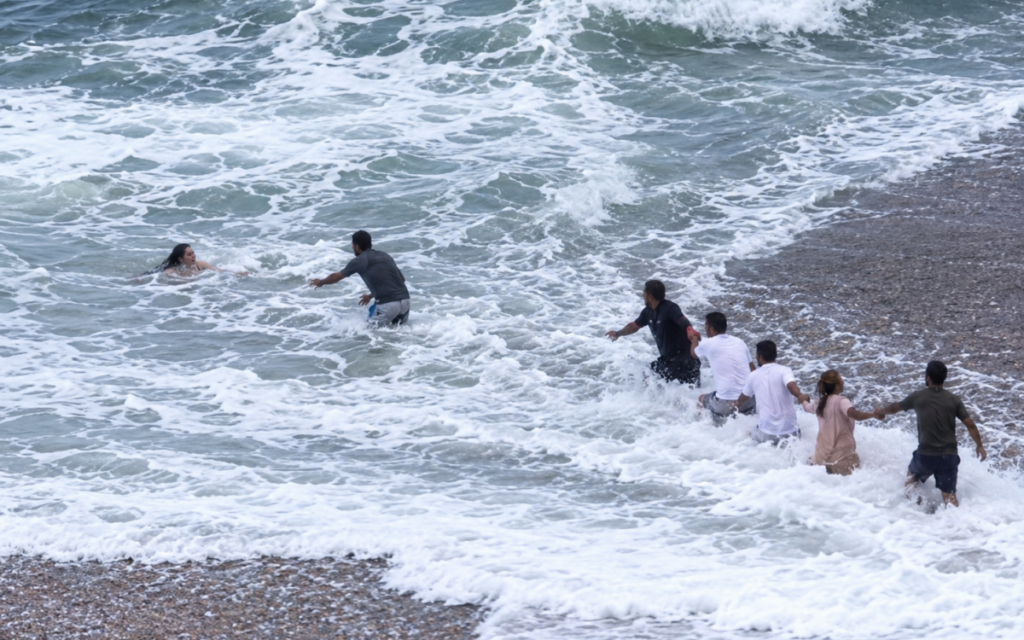
Passersby race to rescue. Credit: Viral on X
A woman swept out to sea while reading on a Spanish beach was saved by around ten strangers who joined hands to form a human chain, in a dramatic rescue that has renewed warnings about the dangers of powerful waves.
The incident happened at Riazor beach in A Coruña, Galicia, at around 2pm on Sunday, October 25. A yellow weather warning for dangerous coastal conditions was in force, with waves of more than four metres forecast along the coast, according to the Spanish weather agency AEMET’s coastal forecast.
According to Spanish media reports, the woman was sitting close to the water when a wave suddenly pulled her into the sea. She was unable to get back to shore under her own strength.
Una cadena humana rescata a un bañista en la Playa de Riazor en A Coruña https://t.co/D8BQb6HXmj
— Alerta Zeta | Sucesos 🇪🇸 (@AlertaZeta) October 25, 2026
Several people rushed to help, but the force of the waves made the rescue difficult. What began with a handful of people grew into a human chain of around ten rescuers, who managed to pull the woman back onto the sand.
Emergency services were alerted at 1.45pm. Ambulance staff and local police attended, and the woman was taken to A Coruña’s university hospital after suffering hypothermia.
Spain’s beaches carry a year-round drowning risk
The rescue is a reminder that dangerous conditions are not confined to swimming areas or the height of summer. Waves can reach further up a beach than expected, even catching people who are sitting on the sand close to the water.
Spain recorded 472 accidental drowning deaths in 2025, according to the National Drowning Report published by the Royal Spanish Lifesaving and Rescue Federation. Beaches accounted for 241 of those deaths, more than half the annual total.
Andalucia recorded 81 drowning deaths, the highest figure of any Spanish region, while Galicia reported 54.
The figures cover accidental drownings across Spain’s aquatic environments, including beaches, rivers and swimming pools. They do not show how many people are swept away by unexpected waves, so the precise frequency of these incidents remains unclear.
EWN previously reported on 13 drowning deaths in Spain over a single weekend, highlighting the risks faced by swimmers and holidaymakers when sea conditions change.
Mayor warns rescuers were also at risk
A Coruña mayor Inés Rey praised the people who helped the woman but criticised the decision to sit so close to the sea in dangerous conditions.
She described remaining beside the water during the warning as highly irresponsible, pointing out that the rescuers could also have been swept away.
The warning is particularly relevant as winter storms approach Spain’s Atlantic coastline. On Monday, October 26, work began to build a protective sand dune more than two metres high at Riazor beach to help reduce the impact of winter waves on the seafront promenade, according to Cadena SER’s report on the coastal protection work.
What should beachgoers do when waves turn dangerous?
Visitors unfamiliar with Spain’s Atlantic coastline should take official coastal warnings seriously and keep well back from the water during rough conditions. A yellow warning should not be interpreted as meaning that every stretch of coastline is safe.
Anyone who sees a person in difficulty in the sea should call 112 and alert emergency services. Entering rough water to attempt an untrained rescue can put additional lives at risk.
EWN has also covered a Calpe beach rescue in which two holidaymakers helped save an 80-year-old woman, demonstrating how quickly members of the public may need to respond when somebody gets into difficulty.
The Riazor rescue ended with the woman being brought to safety, thanks to the quick actions of strangers. It also showed how rapidly apparently ordinary conditions beside the water can become life-threatening.
Follow Euro Weekly News on Google News
Get breaking news from Spain, travel updates, and expat stories directly on your Google News feed.
Follow on Google NewsSign up for personalised news
Subscribe to our Euro Weekly News alerts to get the latest stories into your inbox!
By signing up, you will create a Euro Weekly News account if you don't already have one. Review our Privacy Policy for more information about our privacy practices.




Adam Woodward
Adam is a writer who has lived in Spain for over 25 years. With a background in English teaching and a passion for music, food, and the arts, he brings a rich personal perspective to his work at Euro Weekly News. As a father of three with deep roots in Spanish life, Adam writes engaging stories that explore culture, lifestyle, and the everyday experiences that shape communities across Spain.
Comments