Albox drone pilot launches volunteer fire watch over Almanzora Valley
By Harry Dennis • Published: 27 Jul 2026 • 23:42 • 2 minutes read
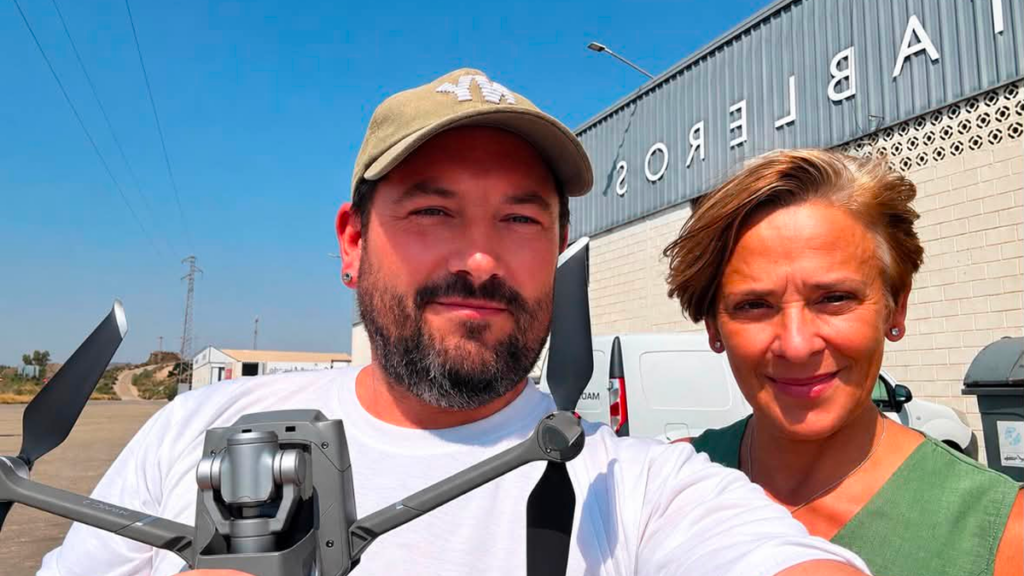
Jonathan Salt with Dolores from Maderas Viudez in Antas, who acted as his visual observer during the drone flight. Credit: Jonathan Salt
Jonathan Salt’s first logged flight over Albox delivered the result every community would hope for: no smoke and no sign of fire. His home-grown project now aims to add another watchful eye during high-risk periods.
A clear first flight over Albox
The first video recorded was uploaded on Sunday July 26, and shows Salt’s DJI Mavic 2 Zoom taking to the air at 7pm over Albox and the surrounding countryside. Conditions were windy and visibility was reduced by heat haze, but the flight reported no smoke or signs of wildfire.
The idea came from worries for people’s safety rather than professional firefighting experience. “Like many people here, I’ve watched the recent wildfires with concern,” Salt told Euro Weekly News. Salt owns several drones and has flown different types of unmanned aircraft for many years. He believed a carefully operated drone could offer a wider view across the countryside, leading him to create Almanzora Valley Fire Watch as a voluntary community initiative.
There is no fixed patrol timetable. Flights will be occasional and determined by suitable weather, legal operating conditions and periods of increased fire risk.
Observation stops when an emergency emerges
Salt is careful to describe the project as observation and reporting, not an emergency response service. “If I ever observe what appears to be a possible wildfire, my priority is to report it immediately by calling 112,” he said. “I would not approach the incident or interfere with the emergency services.”
Spain’s State Aviation Safety Agency, AESA, says drone rules apply regardless of an aircraft’s size. In the commonly used “open” category, pilots must normally keep the drone within visual line of sight, fly no higher than 120 metres and respect local airspace restrictions.
Crucially, civilian pilots must not fly close to or inside an area where emergency operations are under way unless the service in charge has expressly authorised it. Salt said emergency crews would always take priority and that he would follow any restriction or instruction issued during an active incident.
Taking matters into one’s own hands as local support comes before formal partnerships
Salt is now approaching local councils, Protección Civil volunteers and fire services to introduce the initiative and discuss how it can operate responsibly. No formal partnership with an authority has yet been announced.
The public response, however, has been “overwhelmingly positive”, he said. Residents have offered encouragement, while some local businesses have volunteered to act as visual observers during future flights. Salt’s ambition is quite modest but prudent: to improve awareness and encourage faster reporting rather than replace trained services.
“Even if it simply reminds people to stay alert and report suspected fires quickly by calling 112, I would consider that a success,” he said.
Anyone who sees a forest fire or a column of smoke in woodland should alert the 112 Andalucía emergency number promptly.
Follow Euro Weekly News on Google News
Get breaking news from Spain, travel updates, and expat stories directly on your Google News feed.
Follow on Google NewsSign up for personalised news
Subscribe to our Euro Weekly News alerts to get the latest stories into your inbox!
By signing up, you will create a Euro Weekly News account if you don't already have one. Review our Privacy Policy for more information about our privacy practices.

Harry Dennis
Born in the UK and raised on the Cádiz coast, Harry brings his background in design, music, and photography to his writing for Euro Weekly News, sharing stories that celebrate culture and lifestyle across Spain and beyond.
Comments