1,200 Granada tremors later: the earthquake advice Malaga has just sent to 60 towns
By Adam Woodward • Published: 29 Aug 2026 • 11:22 • 4 minutes read
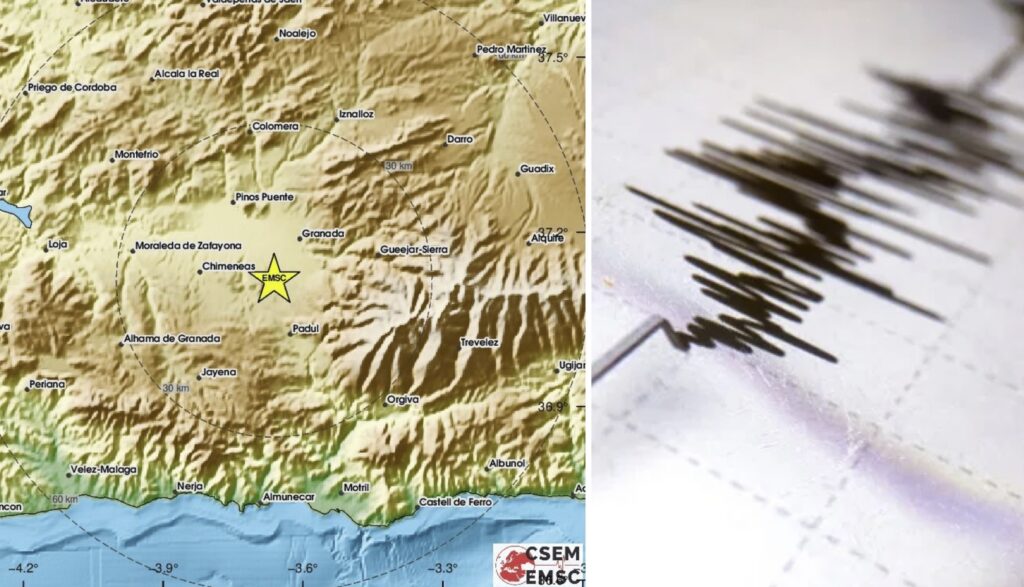
Recent seismic activity and its local effects. Credit: SCEM/MuhsinRina - Shutterstock
Furniture moved. Glasses rattled. Holidaymakers on the eastern Costa del Sol asked the same question as people in Granada flats: if this happens again, what do I actually do? Malaga’s provincial council has now put a written answer in the hands of more than 60 local Civil Protection groups, just as Spain’s National Geographic Institute counts well over 1,200 tremors around Granada in a fortnight.
Luis Rodriguez, deputy for security and emergencies, is not trying to empty the beaches. He wants towns ready, and he wants residents and visitors to hear one clear set of instructions instead of half-remembered tips from a phone scroll. His guide sits on a 2017 seismic hazard map for Malaga province. Town halls are told to class buildings as quake-resistant or not, mark safe outdoor spots, pick evacuation routes, and list who will need help first.
Granada swarm that reached the Costa del Sol
Southern Spain is right on the grind between the African and Eurasian plates. Most shocks stay small. This one did not stay polite. Two magnitude 4.8 quakes, on 15 and 18 August, were shallow enough to be felt from Nerja and Torrox to Almeria, Jaen and Cordoba. Buildings were checked, some people left blocks in Las Gabias, and the Alhambra had visits paused. EWN reported that first overnight jolt when calls hit 112 from almost every Andalusian province. Geologists say a swarm like this can keep going for weeks. Saturday morning still brought smaller ticks in Granada and Jaen.
You can watch new events on the IGN catalogue and file a “I felt it” report if the floor moves.
Malaga province: where the ground is most restless
Risk rises as you travel east and inland. Diputacion mapping puts the hotter band in the Axarquia and the north-east, closer to the Granada fault country that runs through the Boquete de Zafarraya towards Alhama. Names that keep coming up include Alcaucin, Alfarnate, Archidona, Arenas, Competa, Canillas de Aceituno, Colmenar, Comares, Frigiliana, Periana, Riogordo, Sayalonga, Sedella, Vinuela, Villanueva del Rosario and Villanueva del Trabuco. Velez-Malaga, Torrox and Nerja felt August’s Granada shocks more than many western resorts.
Malaga city still has weak spots. Older streets in the centre and land around the Guadalhorce, industry, retail parks, airport approaches, would take a harder knock in a rare large quake. Newer places such as Teatinos are built to later rules. Further west, Estepona, Manilva, Casares and Gaucin sit in a lower hazard band, though the Sierra de Ronda can still produce its own cluster of quakes. A 3.8 shock near Cortes de la Frontera in February was felt down to Marbella.
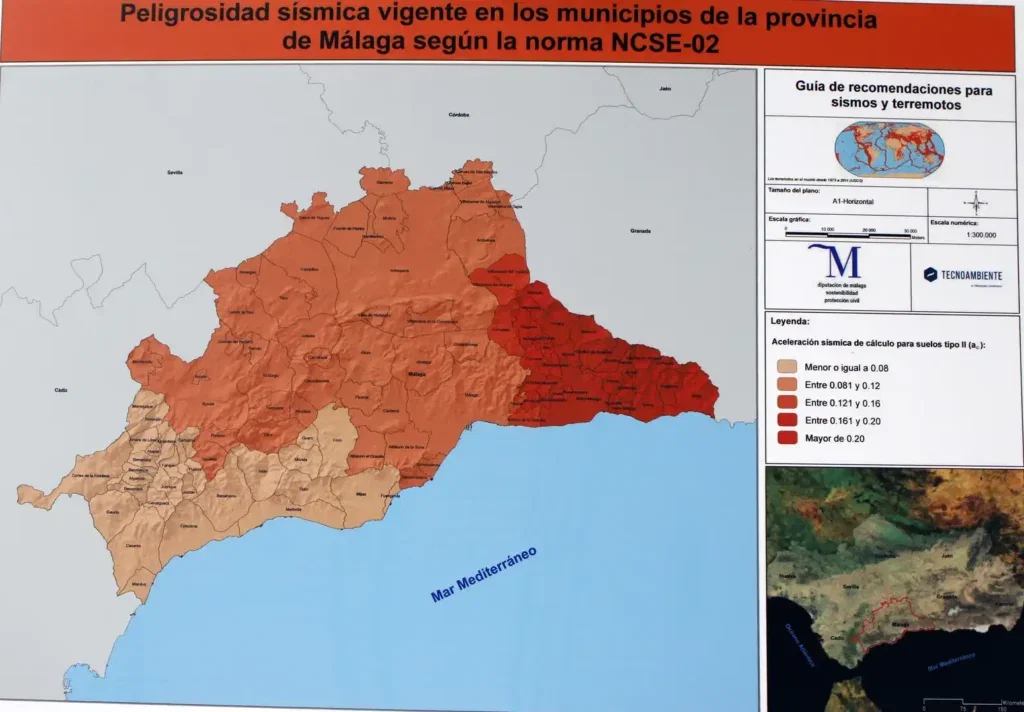
Credit: Diputación de Málaga
Inside a flat, hotel or shop
Treat a modern, quake-resistant building as a place to ride it out. Get away from glass, shelves and anything that can drop. Go under a solid wooden table or against a structural wall and hold on. Open the front door and bedroom doors at the first jolt so they do not jam. Keep shoes on if you can; glass ends up on the tiles. Skip the lift. Skip matches and candles in case a gas pipe has gone. Do not park yourself in a doorway, as that old trick is considered out of date here.
If you know the block is old, poorly built or already cracked, leave when the shaking lets you and stand in open ground away from walls and power lines. If you are in a modern hotel or a recently built block, stay inside, drop, cover and hold on until it stops, then use the stairs.
If you do not know which you are in, the usual rule used by 112 is: do not rush out while it is still moving. Take cover first. Leave after the shaking if the building looks damaged, you smell gas, or staff tell you to go.
Stay in your seat in a cinema or theatre and cover your head until the motion stops. In a supermarket or shopping centre, keep clear of hanging signs and stacked displays.
Outside, in bed or behind the wheel
Move away from facades, lamp posts and power lines. Slow down if you are driving, then stop in a clear patch away from trees and cables. Get up from bed if you can; if you cannot, at least shield your head.
Pack a small kit before you need it: water, food, first-aid bits, a torch and a battery radio. Learn the water, electricity and gas shut-offs in a rental as well as a home. Screw shelves to the wall and keep heavy boxes off the bed.
Rodriguez wants public warnings short, spoken in plain language, and pushed out by loudspeaker, local radio and TV, and mass text. Call 112 Andalucia only for injuries or serious damage. EWN has already run a wider “what to do” briefing; this Malaga note is the local playbook sitting on top of that.
If you are elsewhere in Andalucia
Granada’s Vega is the busy patch right now: Alhendin, Gojar, La Zubia, Ogijares, Armilla, Las Gabias and the southern edge of the capital. Almeria ranks high on official hazard maps too, especially towards the Alboran Sea. Jaen has picked up smaller events in this same sequence. Cordoba usually only usually gets a distant sway. Cadiz and Huelva shake less day to day, but carry more historic tsunami risk from the Gulf of Cadiz. Sevilla and the Guadalquivir valley are among the quieter corners.
Nobody can time the next jolt. You can still decide which table you would get under, which door you would open, and which open square you would walk to. That is the job of the folder now on Civil Protection desks from Nerja to Ronda.
Follow Euro Weekly News on Google News
Get breaking news from Spain, travel updates, and expat stories directly on your Google News feed.
Follow on Google NewsSign up for personalised news
Subscribe to our Euro Weekly News alerts to get the latest stories into your inbox!
By signing up, you will create a Euro Weekly News account if you don't already have one. Review our Privacy Policy for more information about our privacy practices.

Adam Woodward
Adam is a writer who has lived in Spain for over 25 years. With a background in English teaching and a passion for music, food, and the arts, he brings a rich personal perspective to his work at Euro Weekly News. As a father of three with deep roots in Spanish life, Adam writes engaging stories that explore culture, lifestyle, and the everyday experiences that shape communities across Spain.
Comments