British couple on holiday in Morocco face bizarre roadside encounter on final day
By Molly Grace • Published: 20 Sep 2026 • 1:39 • 3 minutes read
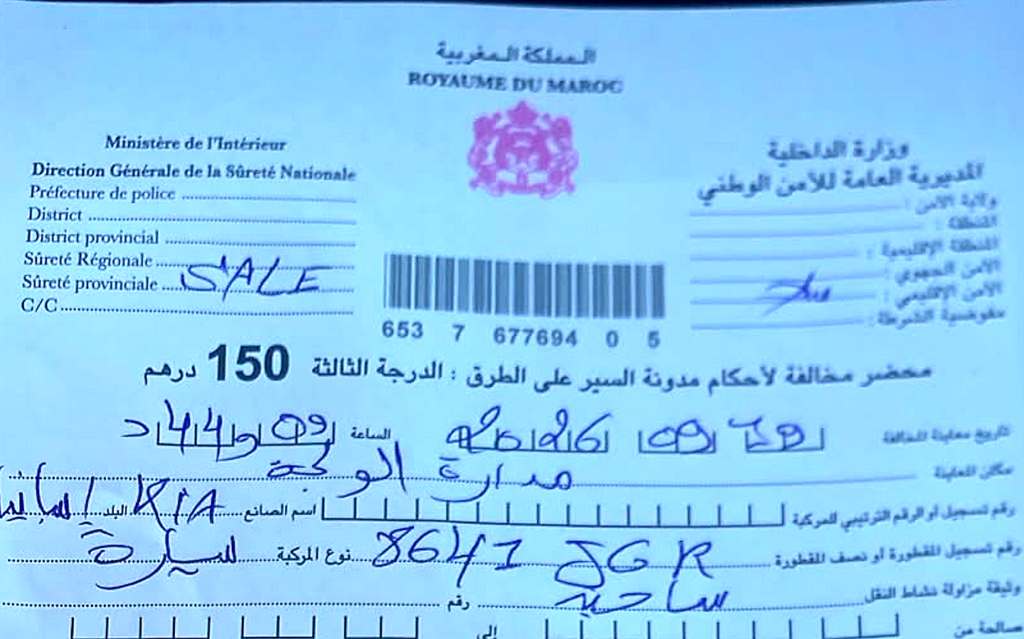
The couple were stopped by a Moroccan police officer. Photo credit: Mary. W
Picture this: you spend a wonderful week driving through Morocco, taking in the sights, food, traditions and some of the country’s most fascinating cities, only to have the whole trip end on an odd note when getting pulled over by a police officer, and that is exactly what happened to a British couple during their Moroccan road trip. Frank and Mary W., who live in Almería, had been looking forward to visiting Morocco for a while.
When they finally managed to arrange their holiday, they spent several days exploring the country. Their trip had taken them through several Moroccan cities, including Fez, Chefchaouen, Al Hoceima and Rabat, giving them the chance to experience the country’s culture and traditions at their own pace. But on their final day, as they were leaving Rabat, the holiday took a turn that left the couple more confused than anything else.
Pulled over by police
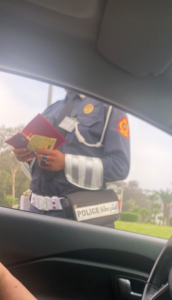
The couple were stopped by a Moroccan police officer, and when Frank asked why they had been pulled over, the explanation seemed remarkably simple. They had, the officer told them, “driven over a white line.” For the couple, that raised more questions than it answered.
They tried to understand exactly what they had done wrong and why crossing the particular road marking warranted a fine, but before they had managed to make sense of the situation, the officer began writing out the penalty. The amount, they were told, was 400 Moroccan dirhams, around €37. There was just one problem: they did not have 400 dirhams on them. That was when the situation became even more confusing.
When a fine starts to look negotiable
After being told they could not pay the full amount, the officer lowered the figure to 350 dirhams, around €32. For the couple, this was difficult to understand. A fine is normally a fixed penalty: you break a rule, you receive the corresponding fine and you pay it. At this point, however, the amount appeared to have some room for negotiation. The officer began haggling with them over how much they could pay, rather than simply telling them how to settle a fixed penalty.
They were not trying to negotiate the fine; they were simply trying to explain that they did not have the amount the officer had initially demanded. Eventually, the officer agreed to accept 150 dirhams, roughly €14, and they were allowed to continue their journey. After a week of sightseeing, driving and exploring Morocco, their final encounter with the country’s roads had left them with a very strange impression of how a traffic fine was supposed to work.
What the rules actually say
There is an important distinction between the couples experience and the formal Moroccan system. Being stopped by police while driving is not unusual in Morocco, and current government travel advice warns motorists that driving conditions can differ considerably from those in Britain and Spain and advises particular care on the roads. Morocco does have an official system of fixed traffic penalties. The country’s General Treasury publishes three classes of road offence, with standard amounts of 700, 500 and 300 dirhams.
Reduced amounts can apply when fines are paid promptly, meaning the amount paid can legitimately vary according to the offence and when the penalty is settled. That is different from what happened here, however. In this case, the amount appeared to change after the couple explained that they did not have enough cash to pay the original 400-dirham demand.
Not necessarily the usual process
There are, however, published reports of corruption involving Moroccan law enforcement, including allegations of officers soliciting money during traffic stops. A 2025 review by the U4 Anti-Corruption Resource Centre, operated in collaboration with Transparency International, says such reports include motorists paying less than the prescribed fine.
That does not establish that corruption occurred in this case, but it pretty well seems like it. The experience left them questioning how the system worked after the officer repeatedly changed the amount he was prepared to accept.
A strange end to the trip
For the couple, the experience left them questioning how the system worked and, in particular, how a penalty could change during a roadside conversation. For anyone from Spain considering driving to Morocco, it is worth remembering that roadside procedures may work differently from those they are used to at home.
A police stop itself is not unusual, and Morocco has formal traffic penalties, but this experience was far removed from the straightforward fixed fine they had expected. They paid their 150 dirhams and were able to continue on their way, but the explanation they were left with was still the same one that had started the whole episode. So remember when visiting, don’t drive over white lines, regardless of where on the road they are located.
Follow Euro Weekly News on Google News
Get breaking news from Spain, travel updates, and expat stories directly on your Google News feed.
Follow on Google NewsSign up for personalised news
Subscribe to our Euro Weekly News alerts to get the latest stories into your inbox!
By signing up, you will create a Euro Weekly News account if you don't already have one. Review our Privacy Policy for more information about our privacy practices.




Molly Grace
Molly is a British journalist and author who has lived in Spain for over 25 years. With a background in animal welfare, equestrian science, and veterinary nursing, she brings curiosity, humour, and a sharp investigative eye to her work. At Euro Weekly News, Molly explores the intersections of nature, culture, and community - drawing on her deep local knowledge and passion for stories that reflect life in Spain from the ground up.
Comments
Roch
20 September 2026 • 02:01Breaking news: Tourists discover that traffic laws exist outside their home country, and the media acts like it’s a human rights violation. They got a receipt and a lenient fine