Asian hornets are heading for the Costas: how to spot a nest this winter and who to call
By Harry Dennis • Published: 10 Nov 2026 • 23:13 • 4 minutes read
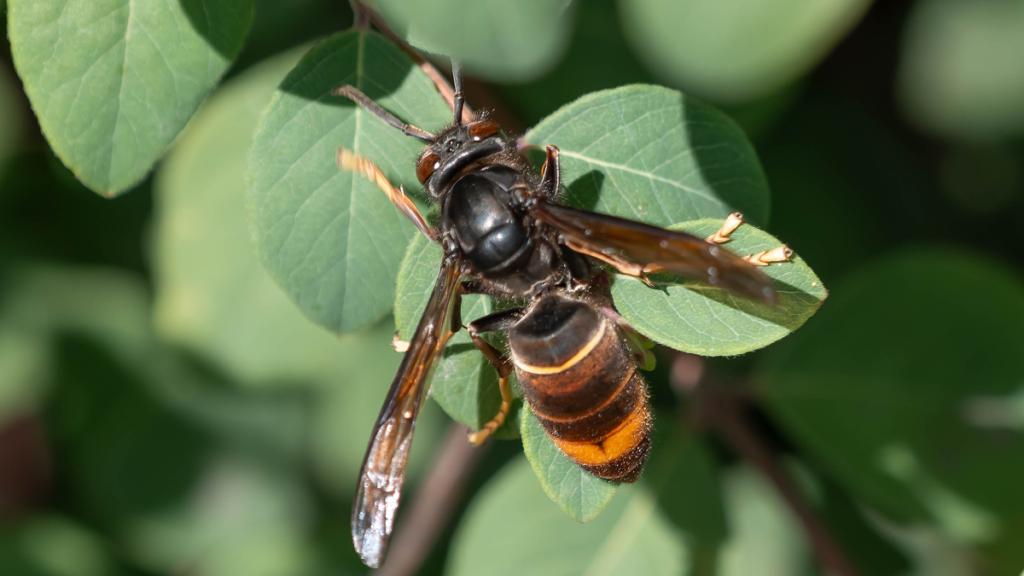
The Asian hornet is spreading south across Spain. Credit: Sebastian Czech / Shutterstock
Beekeepers in northern Spain have spent the year watching hornets pick off their bees at the hive entrance. Now the invasive Asian hornet is turning up far further south, from Castellón to Málaga, Mallorca and the Canaries, and this mild autumn has kept its nests busy for longer.
Beekeepers are watching hives turn into traps
A beekeeper in Álava filmed what his year has looked like this week: around 20 Asian hornets hovering at the mouth of a hive, snatching bees as they tried to leave. “You have no idea what this year has been like,” he said in the video, before calling on the provincial government to do something about it.
No os podéis hacer una idea lo que está siendo este año lo de las avispas asiáticas (Velutinas) pic.twitter.com/6JBGhMJoGT
— Edu F.de Lezeta (@EduLezeta) October 30, 2026
It’s a scene the north knows far too well. The Asian hornet (or Vespa velutina) reached the Basque Country in 2010, six years after it was first found in south-west France. In Urdaibai, in Bizkaia, beekeepers removed 2,587 nests between 2018 and 2025, with 432 of those in the last year alone, while Asturias has trapped more than 800,000 queens since 2018, according to regional figures.
The hornets wait at hive entrances because bees make up close to 80 per cent of their diet. Colonies under siege run short of food and can collapse before winter, and adult hornets also feed on ripe grapes and other soft fruit.
Castellón has logged 68 sightings this year
The bigger worry for anyone living on the Mediterranean coast is just how far south it’s now turning up. Ministry for the Ecological Transition (MITECO) data shows its range more than doubled from 41,700 square kilometres in 2018 to 88,900 by late 2024, which is roughly 17 per cent of the Iberian Peninsula.
In Castellón province, where it was first detected in Els Ports in 2023, the regional agriculture department has recorded 68 sightings in 25 towns so far this year, up to Wednesday November 4.
The Costa del Sol had its first nest in October 2025, high in a pine tree in Alhaurín de la Torre. It weighed around 7.5 kilos and held thousands of larvae, and had it been left a few more days, hundreds of new queens could have flown off to start nests of their own.
The islands haven’t escaped from them either. Firefighters removed nearly 100 Asian hornets from an urban part of Las Palmas de Gran Canaria in May, the first detection in the Canaries, while Mallorca has been fighting the species since 2015 and removed 21 nests in 2024 after it had once been declared wiped out.
Why a warm autumn keeps nests going
Each nest dies off over winter, though not before it’s produced a new generation of queens, which leave in autumn, find a sheltered spot to sit out the cold and then each start a brand new nest in spring.
So the longer the warm weather lasts, the longer nests stay active and the bigger they can grow. Experts warned this week that a late arrival of cold weather can stretch the hornets’ life cycle and leave larger nests with more hornets in them, and Spain has just come through its hottest September since records began in 1961, at 3.4 degrees above normal.
November is also when nests are easiest to spot. Once the leaves drop, the big, round papery nests the hornets build high in trees suddenly come into view, and reporting them, even empty ones, helps authorities map where the species is active and where to set traps in spring.
How to tell it apart from Spain’s other hornets
Not every big hornet buzzing round the pool is an Asian hornet. On the southern Costas, it’s more likely to be the oriental hornet (or Vespa orientalis), a separate invasive species that’s been spreading across Andalucía since it was found in the Campo de Gibraltar in 2018.
The Asian hornet has a dark, almost black body with a single orange-yellow band near the tail, yellow tips on its legs (which is why the UK calls it the yellow-legged hornet) and an orange face. The oriental hornet is reddish-brown with a thick yellow stripe across its body and a bright yellow face, and usually nests in walls, cavities or underground. The native European hornet is bigger, striped brown and yellow, and generally leaves people and bees alone.
Neither is the ‘murder hornet’ of viral headlines, which is a different species altogether. An Asian hornet’s sting isn’t necessarily more dangerous than any other wasp’s, though it can trigger serious allergic reactions and several stings at once can cause complications.
Brits back home are facing the same fight
The UK is going through its own surge. Last year brought a record number of sightings, and by Thursday October 29 this year, 88 nests had already been found in 2026 from 234 credible sightings, according to the National Bee Unit.
People in Britain report them through a single app, Asian Hornet Watch. In Spain, it depends on where you live, as each region runs its own system.
Never try to remove a nest yourself
Authorities across Spain are clear that nobody should touch, spray or try to knock down a nest, as hornets defend it aggressively. Low nests built in spring, in sheds, hedges, brambles or under eaves, are the riskiest to stumble on.
Instead, take a photo or video from a safe distance, note the exact location and report it. In the Comunitat Valenciana, the advice is to call 112. In the Balearics, the species protection service takes reports by WhatsApp on 606 875 244, and in the Canaries the Early Warning Network for Invasive Exotic Species does the same on 646 60 14 57.
So if a bare tree on your street suddenly reveals a nest the size of a football this winter, keep your distance, get a photo and report it, as it’ll help teams know where to put traps for the queens when they wake up in spring.
Follow Euro Weekly News on Google News
Get breaking news from Spain, travel updates, and expat stories directly on your Google News feed.
Follow on Google NewsSign up for personalised news
Subscribe to our Euro Weekly News alerts to get the latest stories into your inbox!
By signing up, you will create a Euro Weekly News account if you don't already have one. Review our Privacy Policy for more information about our privacy practices.





Harry Dennis
Born in the UK and raised on the Cádiz coast, Harry brings a creative eye to his writing, sharing stories that celebrate culture and lifestyle across Spain and beyond.
Comments