4.3 earthquake rocks Pisa as crowds rush into streets and trains grind to a halt
By Harry Dennis • Published: 04 Aug 2026 • 16:50 • 2 minutes read
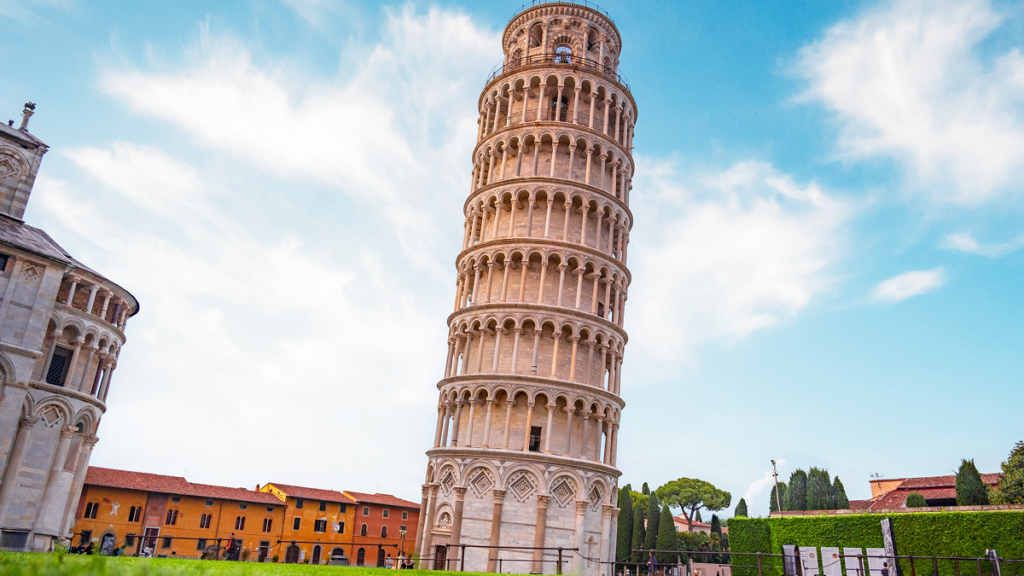
Pisa’s famous monuments remained open after the magnitude-4.3 earthquake. Credit: zedspider / shutterstock
Office workers, court staff and residents suddenly found themselves out in the street while railway passengers waited for engineers to inspect the tracks. The shallow jolt struck just outside Pisa, close enough to bring the city’s most famous lean immediately to mind.
The 10:15am jolt that sent northern Tuscany outside
A magnitude-4.3 earthquake struck near Pisa at 10.15am local time on Tuesday August 4, according to Italy’s National Institute of Geophysics and Volcanology (INGV). Its epicentre was around 6.7 kilometres south-west of Pisa, in the area of the San Rossore regional park, at a depth of approximately eight kilometres. The shaking was felt across a surprisingly wide area. Reports reached INGV from the provinces of Pisa, Livorno, Lucca, Florence and La Spezia, with people also registering the tremor as far away as Genoa and Bologna.
In Pisa, residents and workers poured into the streets. Court hearings were briefly interrupted, the town hall was evacuated as a precaution and firefighters received requests to inspect homes in the city centre. Livorno’s municipal offices were also temporarily evacuated before staff returned.
Despite the alarm, Tuscany’s regional authorities said their initial inspections had found no injuries or damage to homes, public buildings or other important infrastructures.
No need to fret, the Leaning Tower isn’t leaning more than before
Despite the obvious temptation, there is no evidence that the Leaning Tower of Pisa is leaning any further. Checks found no damage or safety concerns at the tower or the other museums and monuments in Piazza dei Miracoli. Safety measures remained unchanged and the attractions continued to welcome visitors.
Tourists can therefore keep taking their photos pretending to hold the tower upright, without claiming the earthquake gave them any assistance.
A 3.2 aftershock kept people’s nerves on edge
The first tremor was then followed by a series of smaller shocks. INGV recorded five aftershocks below magnitude 2.0 during the following hour. Later on, a more noticeable magnitude-3.2 tremor struck at 1.04pm, with its epicentre around five kilometres from Pisa and at a depth of 11 kilometres. A magnitude-2.3 shock had been recorded shortly beforehand.
The Tuscany regional government convened its crisis unit, bringing together civil protection teams, prefectures, councils, emergency services and infrastructure operators. Pisa, San Giuliano Terme and Vecchiano also activated their municipal emergency coordination centres while technicians began checking sensitive public and private buildings.
Four rail corridors stopped for engineers
Rail traffic was suspended as a precaution on the Pisa–Empoli, Pisa–Livorno, Pisa–Lucca and Pisa–Viareggio lines. Rete Ferroviaria Italiana engineers were sent to inspect tracks and other infrastructure before trains could be cleared to run again. Replacement buses were reportedly introduced while those checks continued.
The Tuscan coast has shaked before
INGV classifies the affected area as having medium seismic hazard. Instrumental records since 1985 show that local earthquake activity has been concentrated largely along the coast between Pisa and Livorno. The strongest known historical earthquake in this part of Tuscany struck around Orciano Pisano in August 1846 and has been estimated at magnitude 6.0.
For Tuesday’s considerably smaller quake, it stopped trains, emptied offices and rattled nerves, but the latest inspections found no injuries or significant damage. Pisa’s most famous resident also survived the morning without adding to its celebrated tilt, leaving tourists, once again, to provide all the dramatic leaning.
Follow Euro Weekly News on Google News
Get breaking news from Spain, travel updates, and expat stories directly on your Google News feed.
Follow on Google NewsSign up for personalised news
Subscribe to our Euro Weekly News alerts to get the latest stories into your inbox!
By signing up, you will create a Euro Weekly News account if you don't already have one. Review our Privacy Policy for more information about our privacy practices.

Harry Dennis
Born in the UK and raised on the Cádiz coast, Harry brings his background in design, music, and photography to his writing for Euro Weekly News, sharing stories that celebrate culture and lifestyle across Spain and beyond.
Comments