Igualeja fire tamed as first autumn rain reaches Malaga: Spain’s 2026 wildfire season in numbers
By Adam Woodward • Updated: 28 Sep 2026 • 10:27 • 2 minutes read
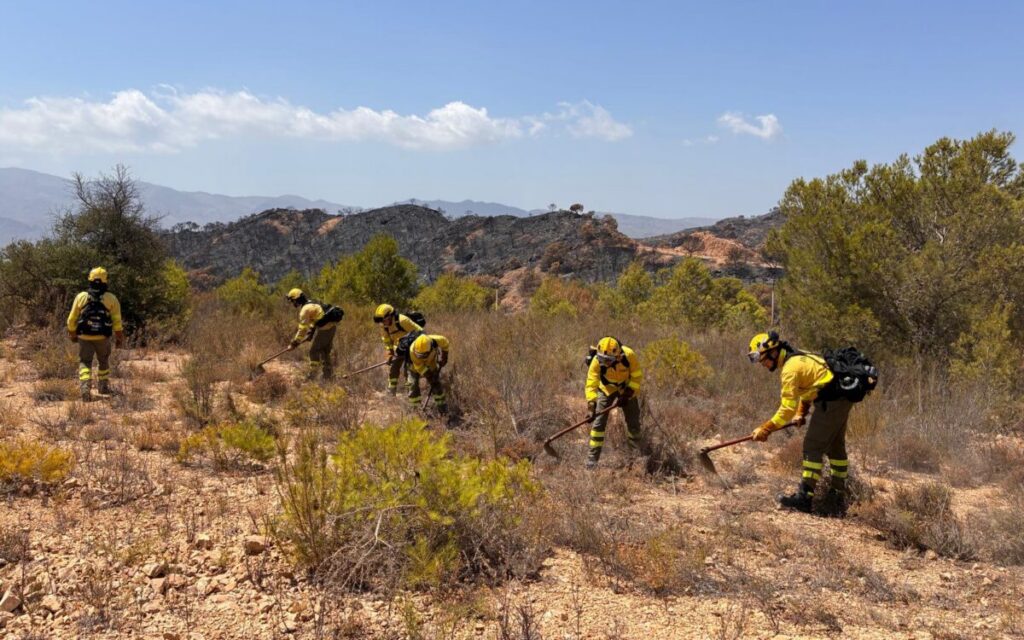
Plan INFOCA fire teams armed with little more than shovels. Credit: EMA X
Clouds finally paid Malaga a visit on Monday after a weekend that put two small Serrania de Ronda villages on edge. Plan Infoca declared the Igualeja wildfire stabilised at about 7.50PM on Sunday, September 27, lifted indoor-stay orders in Igualeja and Parauta, and sent about 50 people back from bars, a petrol station and a coach trip. No active fronts were reported. Ground teams stayed on hot spots and the A-397 overnight so the blaze could be pushed to full control and put out.
Flames first showed at 10.19pm on Saturday, 26 September, near the Mirador de Igualeja, hard country with plenty of dry scrub. Gusts to 60 km/h jumped the San Pedro–Ronda road twice and threatened Sierra de las Nieves National Park. More than 200 firefighters and up to 22 aircraft answered. Homes were not lost. That is a tight, professional result after a nasty night.
Rain has arrived. High-risk season is not quite done
AEMET posted a yellow rain warning for the Costa del Sol, Guadalhorce and Antequera on Monday, with showers, odd thunder and highs nearer 24–25C. Official high-risk cover in Andalucia still runs to 15 October. A few millimetres will not soak every south-facing slope. Antonio Sanz said September and October can still bite, so common sense still applies: no burning, care with machines and cigarettes.
How Igualeja was not quite one of Spain’s worst 2026 fires
Igualeja was a local scare, not a national catastrophe. Spain’s 2026 season has already eaten well over 260,000 hectares by early September, with more than 40 “great fires” of 500 hectares or more. Provisional MITECO figures put three monsters at the top: Niebla (Huelva, from 6 August), about 39,821 ha; Burgohondo (Avila, from 22 July), about 33,943 ha; La Mierla (Guadalajara, from mid-July), about 32,000 ha. Niebla is now listed as Spain’s largest recorded fire by area. EWN covered that Huelva jump in real time: embers leaping 3.5 km in 15 minutes. Burgohondo was tracked as a record-scale inland blaze.
Closer to home, the September 13, Benahavis fire burned roughly 300 to 380 hectares near the Ermita del Rosario. About 50 people left Montemayor. A 78-year-old man later died of burns after refusing to leave his house. See Benahavis stabilised. An earlier July fire on the Estepona–Benahavis line emptied nearly 2,000 homes for a spell: return home after containment.
What started them, and how crews coped
🔥 ESTABILIZADO el #IFIgualeja
🏘️ Finalizan todas las medidas de protección a la población:
➡️ Se dan por terminados los confinamientos preventivos de #Igualeja y #Parauta
➡️ Pueden regresar las 11 personas alejadas de los diseminados.
🚒 El operativo continúa trabajando… pic.twitter.com/UJcvv3CMEe
— EMA 112 (@E112Andalucia) September 27, 2026
Investigators have not yet published a cause for Igualeja. Sanz said power poles look unlikely at first glance and that about 95 per cent of Spanish fires tie back to people. Benahavis is also unconfirmed. July’s AP-7 incident was linked to a vehicle fire on the verge. The second big Benahavis fire is still under investigation. Nationally, heat, wind and bone-dry fuel did the rest once a spark landed.
Credit where it is due: Infoca, provincial brigades, the UME on the mega-fires, and 112 Andalucia kept villages standing. Igualeja never reached the park. Benahavis did not take houses. Niebla and Burgohondo needed days and huge air fleets; those were different beasts. The growing-in-popularity app Wildfire Watch has proved to be an essential tool this year. Rain now gives Malaga breathing space. It does not write off October risks just yet though.
Follow Euro Weekly News on Google News
Get breaking news from Spain, travel updates, and expat stories directly on your Google News feed.
Follow on Google NewsSign up for personalised news
Subscribe to our Euro Weekly News alerts to get the latest stories into your inbox!
By signing up, you will create a Euro Weekly News account if you don't already have one. Review our Privacy Policy for more information about our privacy practices.




Adam Woodward
Adam is a writer who has lived in Spain for over 25 years. With a background in English teaching and a passion for music, food, and the arts, he brings a rich personal perspective to his work at Euro Weekly News. As a father of three with deep roots in Spanish life, Adam writes engaging stories that explore culture, lifestyle, and the everyday experiences that shape communities across Spain.
Comments